The Room as Soul: Anchorholds, Temenos, and the Analytic Container
A room is never only a room.

At least not in the old stories, not in dreams, not in therapy, and not in the kind of fiction that returns to houses as though they were vessels of memory. A room may be a shelter or a trap, a shrine or a sickroom, womb or tomb, a studio or a confessional. Sometimes a room is a stage, hiding place, or a place of ordeal. Maybe it keeps the world out, or perhaps gathers the world into itself until the walls begin to speak. The moment a threshold is crossed, and the door is closed, the space changes.
That’s why the medieval anchorhold, a small cell or hermitage where a religious recluse, known as an anchorite or anchoress, lived, continues to fascinate me. The anchorhold wasn’t merely a quaint religious curiosity, nor only a harsh architectural fact. It was a room transformed into destiny. The anchorite, male or female, enclosed beside the church, withdrew from ordinary social life and entered a space of radical inwardness. They weren’t simply alone; they were placed inside a structure that made solitude visible. The cell became a kind of living metaphor: the soul held apart, the body disciplined, the voice narrowed, the gaze arranged through windows. The anchorite was dead to the world in one sense, yet strangely present to it in another, available as witness, counsel, intercessor, and holy anomaly.

In Ancrene Wisse, written by an unknown author, though scholars generally agree the text was written by a West Midlands cleric or chaplain around 1230, the enclosed life is not treated as pure abstraction. Concerned with three well-born enclosed sisters, the text’s power lies partly in its attention to the practical and bodily conditions of sanctity. The anchoritic life is spiritual, yes, but it’s also architectural, domestic, sensory, and regulated by the stubborn facts of embodiment. There are visitors—engaged through a window. There is food—passed through a window. There is Mass—seen through a window. And there is speech to be guarded, appetite to be watched, attention to be trained. The soul doesn’t hover above the body like a pale flame. The soul is embodied, inhabiting a small room, a cell. Within the body, the soul listens through walls and windows. The embodied soul eats and suffers weather. It is distracted, consoled, tempted, and steadied by the material world.
Cate Gunn’s study, Ancrene Wisse: From Pastoral Literature to Vernacular Spirituality, is helping me think about this text not only as a rule for enclosed women but as part of a larger movement in which spiritual instruction entered a more intimate language. That movement matters to a novelist because vernacular spirituality isn’t just a religious category; it’s also an imaginative one. To write the sacred in the vernacular is to bring it nearer to breath. It suggests the passage from institution to inwardness, from clerical structure to lived feeling, from official doctrine to the local language of the body and the room. The sacred leaves the Latin choir and enters the chamber, the hand, the habit, the daily fear, the whispered prayer.
That crossing point is where literature begins to glow.
The anchorhold belongs to a family of charged spaces. Jung used the old Greek word temenos for a sacred precinct, a bounded area set apart for transformation. In ancient usage, a temenos was marked off from ordinary ground and dedicated to a god, such as a sanctuary, holy grove, or holy precinct. Within it, another order applies. The world outside doesn’t vanish, but it’s held at a distance, and what occurs within the enclosure becomes intensified, ritualized, more dangerous, and more meaningful. The temenos isn’t safe in the bland modern sense. It’s safe enough for danger to appear in either anchorhold or temenos.
That phrase may be the key.
The true sacred enclosure isn’t a place where nothing happens. It’s a place where what needs to happen finally occurs without being immediately scattered, denied, or profaned. It gives form to what would otherwise flood or dissipate. The temenos allows the psyche to reveal itself because the boundary says: here, and not everywhere. It says now, and not always now; this work, and not the noise of the world.
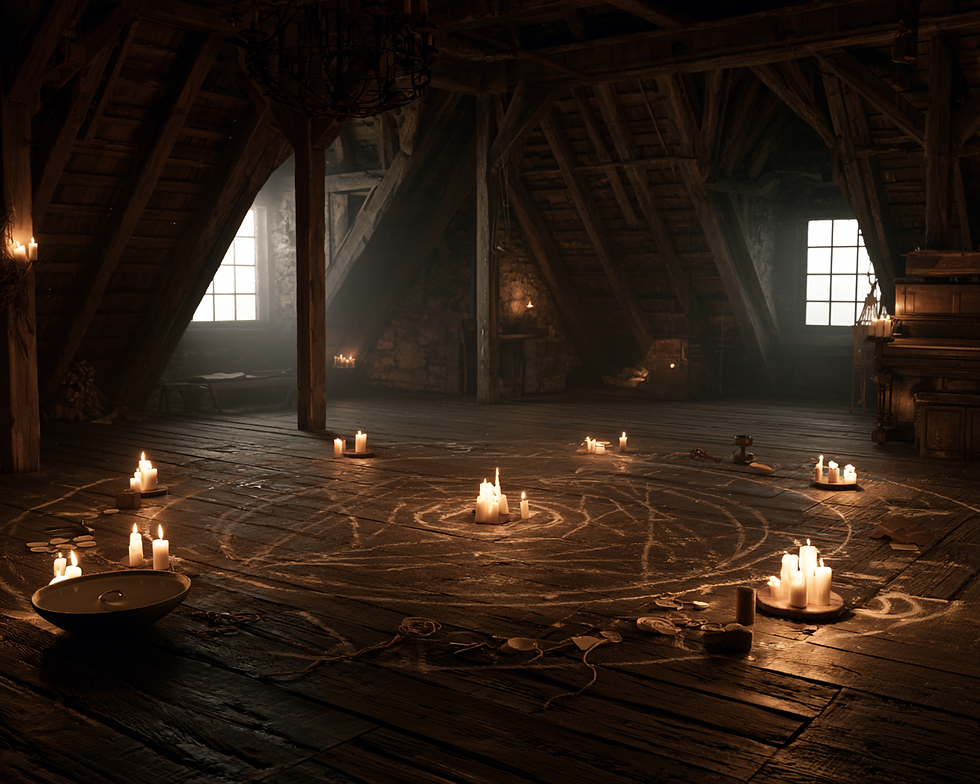
The magic circle works in a similar way. In ritual imagination, the circle does not create meaning out of nothing. It marks a limit so that meaning can gather. Inside the circle, gesture, word, object, and body are no longer casual. A candle isn’t just a candle. A bowl of water isn’t just water. A knife, a thread, a rosary, a pinch of salt, a line drawn in chalk, a whispered name: each object becomes more than itself because it’s been brought inside a boundary of intention. Within the circle, the ordinary world becomes symbolic.
The analytic room, at its best, is another version of this ancient pattern. Therapy depends on an enclosure, though we often pretend otherwise in our modern, clinical language. There’s a room, or now sometimes a screen, but these are still frames like the therapy hour and the fee. There are limits around touch, speech, privacy, repetition, and disclosure. There is the witness, not a priest or magician, but another human being trained to hold the charged field without prematurely breaking it.
The analytic container isn’t a metaphor in any shallow sense. It’s the condition that makes certain forms of speech possible. A patient might say in that room what can’t be said at the dinner table, in the marriage bed, in the office, in the family kitchen, or even to the self in solitude. The room receives projections, ghosts, longings, erotic confusions, griefs, old rages, and infantile terrors. It becomes, for a while, the place where the unspeakable learns language.
That’s why the room is so powerful in fiction. A room can be psyche made visible. A house can hold inheritance within beams and staircases. An attic can be the unconscious, and a cellar can be the ancestral underworld. A studio can be a monastic cell disguised as an artistic vocation. A bedroom can be both refuge and theatre. A chapel can be a scarred psyche.
The anchorhold is especially potent because it refuses to settle into one meaning. Is it a prison or a sanctuary? Sacrifice or self-possession? Death chamber or womb? The answer is yes, and that ambiguity is why it continues to breathe in the imagination. The anchoress is enclosed, but not simply erased. She has withdrawn, but also become strangely magnetic. She is hidden, yet her hiddenness gives her symbolic power. She renounces ordinary life, yet the village or parish may organize a secret part of its psychic life around her presence.
In that sense, the anchorhold is not only a room beside a church. It is a paradox built out of stone.

Modern readers are tempted to treat enclosure as horror because we belong to a culture that often imagines freedom as motion, choice, exposure, and continual availability. We distrust walls, sometimes rightly. Yet the older imagination knew that unboundedness can also be a terror. To be without a boundary is to be vulnerable to invasion, dispersion, and formlessness. The self requires thresholds. Children need rooms. Lovers need doors. Artists need studios. Patients need sessions. Mourners need rituals. Even rebellion needs a circle in which to gather its force.
Seen through Irvin Yalom’s four ultimate concerns, death, freedom, isolation, and meaninglessness, the anchorhold becomes a chamber of existential concentration. Death is ritualized in the enclosure itself, freedom is both surrendered and strangely intensified, isolation is made literal, and meaninglessness is answered, or at least challenged, by vocation. The anchorhold does not solve these terrors. It gives them walls. The danger, of course, is that the sacred room can curdle. The temenos can become a cult chamber. The analytic container can become dependency or seduction if the frame is violated. The magic circle can become an obsession. The anchorhold can become punishment disguised as holiness. Every charged enclosure has a shadow. A boundary can protect, but it can also imprison. A room can shelter the soul, but it can also teach the soul to fear the world.
Shirley Jackson belongs more fully to another essay, but she flickers at the edge of this one. Jackson understood that houses are moral and psychological organisms. Her rooms do not simply contain disturbed people; they collaborate with disturbance. They intensify it. They give it wallpaper, corridors, locked doors, meals, rituals, and names. The haunted house is what happens when the container is no longer trustworthy, when the boundary that should shelter the self begins to feed on it.
But the answer to the bad room isn’t no room. The answer is the right room, the room whose boundaries are honest, whose threshold can be crossed in both directions, whose silence doesn’t devour speech but ripens it.
In my own fiction, I keep returning to such spaces: attics, studios, lake houses, grottoes, hidden chambers, bedrooms, thresholds, anchorholds. It’s not accidental. If you’ve ever had that dream of being in a building you’ve never seen that feels familiar, and you keep discovering more rooms you never knew were there, you know what I mean. Those rooms aren’t backdrops or scenic scaffolding. They are potentials. A character might enter them and become more intensely herself, sometimes against her will. The room concentrates all that she’s avoided. It makes family memory spatial. It turns inheritance into atmosphere. It gives trauma a door, and sometimes, if grace is possible, it gives the door a key.
In my unpublished novel In Her Blood the River Flows, Moira and Nell encounter a door in the attic that should not be there. The scene draws directly on this old intuition: that a room may be a threshold, and that a threshold may be waiting for the person who can finally see it.
Here is a brief extract from the unpublished manuscript of In Her Blood the River Flows.
In the refracted light, a shape appeared: a narrow door, hidden behind drooping tarps, stacked boxes, and the brittle limbs of an artificial Christmas tree. It wasn’t concealed, exactly, but seemed unseen by choice, whatever that meant. The door seemed to recede when viewed directly, emerging only when viewed from the corner of the eye. It gave the impression of floating, unmoored to any wall or structure.

“Have you ever seen that door before?”
Nell shook her head. “Never. And I’ve been up here a hundred times.”
They stepped back together and studied it. The air around the door shimmered, distorted by heat or some strange psychic energy. Moira’s stomach twisted with vertigo; the door was hard to look at, sliding sideways out of focus. Opa Jakob’s Hausgeister, she thought. We should have brought them beer.
Music and laughter drifted up from below: the last fragile thread to the ordinary world.
The room as soul isn’t a simple metaphor. It’s an old human recognition. We’ve always known that inward life needs architecture. We build temples because the sacred requires a precinct. We cast circles because the invisible requires a boundary. We sit in consulting rooms because pain requires a container. We close the studio door because making art requires a different weather. We imagine anchorholds because a part of us still believes that the soul, under sufficient pressure, might become audible.
And perhaps that’s the deepest link between the anchoress, the analysand, the artist, and the fictional character standing before a forbidden door. Each enters a bounded space not merely to hide, but to undergo. The room is not an escape from the world. It is the place where the world, at last, becomes interior enough to be transformed.


Comments